The portal is now on VCF Automation 9.1.1, but teams still order VMs through the same forms and service contracts. TOP rejects the big-bang switch: the VM Apps organization keeps serving while the team rebuilds an All Apps offering and has a small group test it.
The running example is a concrete service: VM + IP + DNS + CMDB. We will decide what stays in place, what must be rebuilt, how to route requests to a new implementation, and what evidence is needed before the old service can be retired. This is an operating plan to adapt and test, not a report of a migration that has been performed.

Sources checked on 25 October 2026. Qualify the 9.1 family capabilities on the selected 9.1.1 build, including prerequisites and entitlements. No executed migration or guaranteed performance is claimed.
TL;DR
- Keep the existing service running after the upgrade and build each All Apps replacement alongside it, using a shared acceptance contract.
- Do not mistake coexistence for conversion. Historical deployments remain managed by their original model; no converter transfers them automatically.
- On Monday morning: choose a low-risk service, list its consumers, and test create, Day2, delete, and cleanup before opening a pilot.
One bimodal platform, two management lanes
VCF Automation 9.1 documents a bimodal model in which VM Apps and All Apps organizations can share the same vCenter and NSX Local Manager. This Mixed Tenancy Mode option requires, among other things, a Supervisor with VPC Networking. For a shared vCenter/NSX pair, the VM Apps organization must be fully configured—including its vCenter and NSX cloud accounts—before the All Apps Region. KB 444058 and 443541 describe the order and the errors that can occur if it is reversed. Broadcom’s shared design presents this as an architecture choice to qualify.
Sharing the pair does not transform the organization, merge tenants, or give two managers control over the same deployment. A dedicated All Apps infrastructure is another architecture option if its cost and management separation are justified. It is not a conversion button. For workloads that remain in VM Apps, actions and operational ownership stay on their current lane.
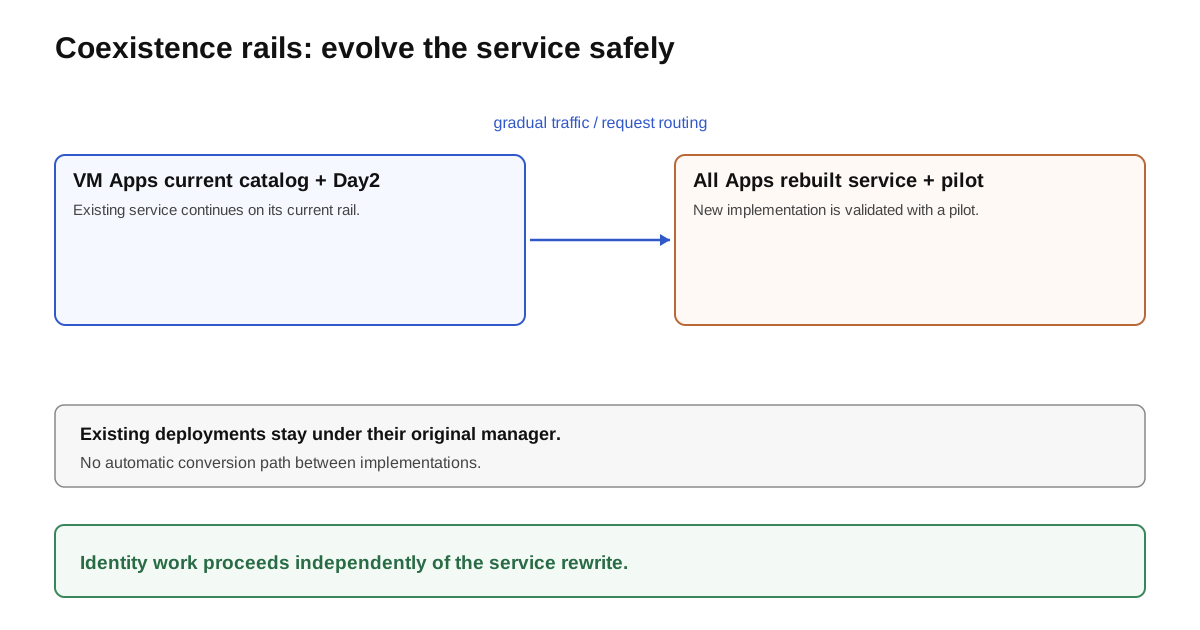
Identity migration is not an implicit step in this rewrite. VM Apps identity migration is a separate workstream: see the dedicated identity migration episode. Keeping two service lanes does not decide which identity provider to use or when the VM Apps tenant switches.
Define the contract before rebuilding
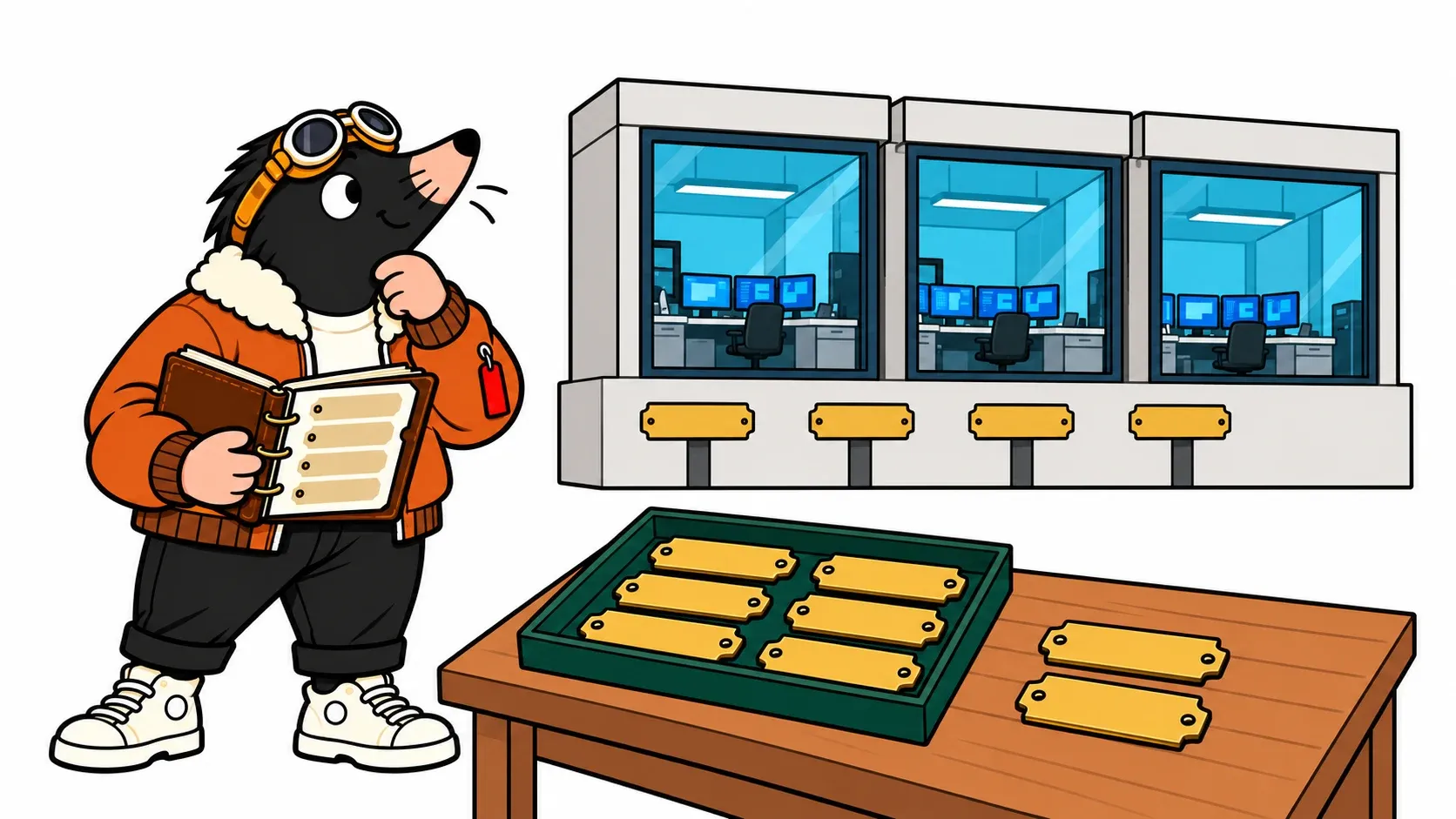
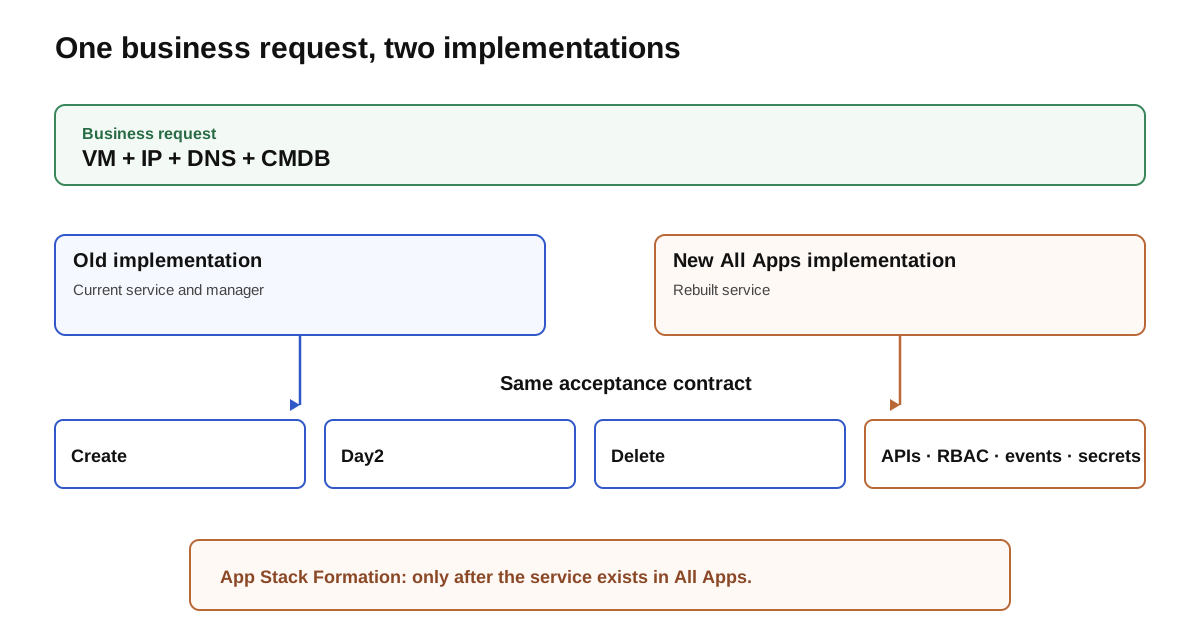
The ticket “create a VM” hides several commitments: allocate an address, create or update a DNS record, register ownership in the CMDB, expose status, renew or change the service, and clean everything up on deletion. The catalog item’s name is not the contract. The contract describes the expected outcome and proof of success independently of the implementation tool.
| VM Apps item to inventory | All Apps equivalent or decision | Evidence to require |
|---|---|---|
| Cloud Template and profiles | Supervisor APIs and objects; suitable classes, image, storage, and network | Placement and inputs produce the expected result |
| Custom form | API schema and request experience | The same business choices are validated server-side |
| ABX, EBS, or Orchestrator workflow | Explicit integration or external service | Errors, retries, and timeouts are handled |
| Day2 actions and rights | API operations, RBAC, and policies | The right persona can act and others are denied |
| Notifications and events | All Apps event topics and an adapted consumer | Events trigger idempotent work; they do not replace a transaction |
| IPAM, DNS, CMDB, secrets | Integration contracts and managed credentials | Create, update, retry, and cleanup are traceable |
This table helps discover gaps; it does not promise an object-for-object mapping. Do not assume existing YAML templates, event subscriptions, or extensions can be copied unchanged. The All Apps IaaS event topics provide signals for integrations. Design consumers to be replayable and verify event behavior on the target build.
Build one vertical slice, not an entire catalog
For the pilot, TOP chooses a low-criticality internal VM class, a VPC network, an approved image, and a subnet with a controlled address allocation process. The team configures the Region, its quotas and limits, then creates a Namespace with the expected resource contract: VM Service, VM classes, Content Library images, storage, and network. It tests the service lifecycle through the APIs and roles that are actually intended.
The rewrite does not require moving every component to Kubernetes. A VM remains appropriate when the service depends on an operating system or software that needs one. VKS or Container Service belongs in the design only if the service benefits from running as a container; that choice brings its own skills, operations, and controls.
New capabilities can be grouped by the value they bring to the service: VPC Networking and IPAM for the network contract; Region quotas and policies for governance; project content libraries and VM Groups for images and grouping; APIs and Terraform for integration; secrets to keep credentials out of scripts. Broadcom’s VCF 9.1 overview surveys the capabilities; choose those with a testable use case and an owner.
Use this qualification checklist for the new operating model. A capability joins the service only after a test and an owner decision; an announcement alone is insufficient.
| Capability to qualify | Change to our service | Additional acceptance check |
|---|---|---|
| VM Service, VKS, Container Service | Choose the runtime for the application need | Operations, update and deletion by the intended persona |
| VPC, IPAM and connectivity | Define explicit network boundaries and routes | Address allocation/release, DNS, filtering and no overlap |
| Project library, VM Groups | Version images and VM groups | Authorized publication and consistent start/stop |
| Fast Deploy | Qualify the image provisioning path | Measure elapsed time and verify disks and later operations |
| Quotas, policies, estimated pricing | Express permissions, limits and cost visibility | Quota denial, approval, lease and understandable estimates |
| APIs/Terraform and secrets | Version contracts and parameters without embedding secrets | Repeated execution, rotation and least privilege |
App Stack Formation can help capture a service once it already exists in an eligible All Apps Namespace. It is not a VM Apps Cloud Template converter. First deploy and validate the application on the All Apps lane, then consider capture and review the generated blueprint, following the Namespace capture guide. The deep dives on Mixed Tenancy, Cloud Template and extension migration, and App Stack Formation cover these topics in more detail.
Route consumers with a way back
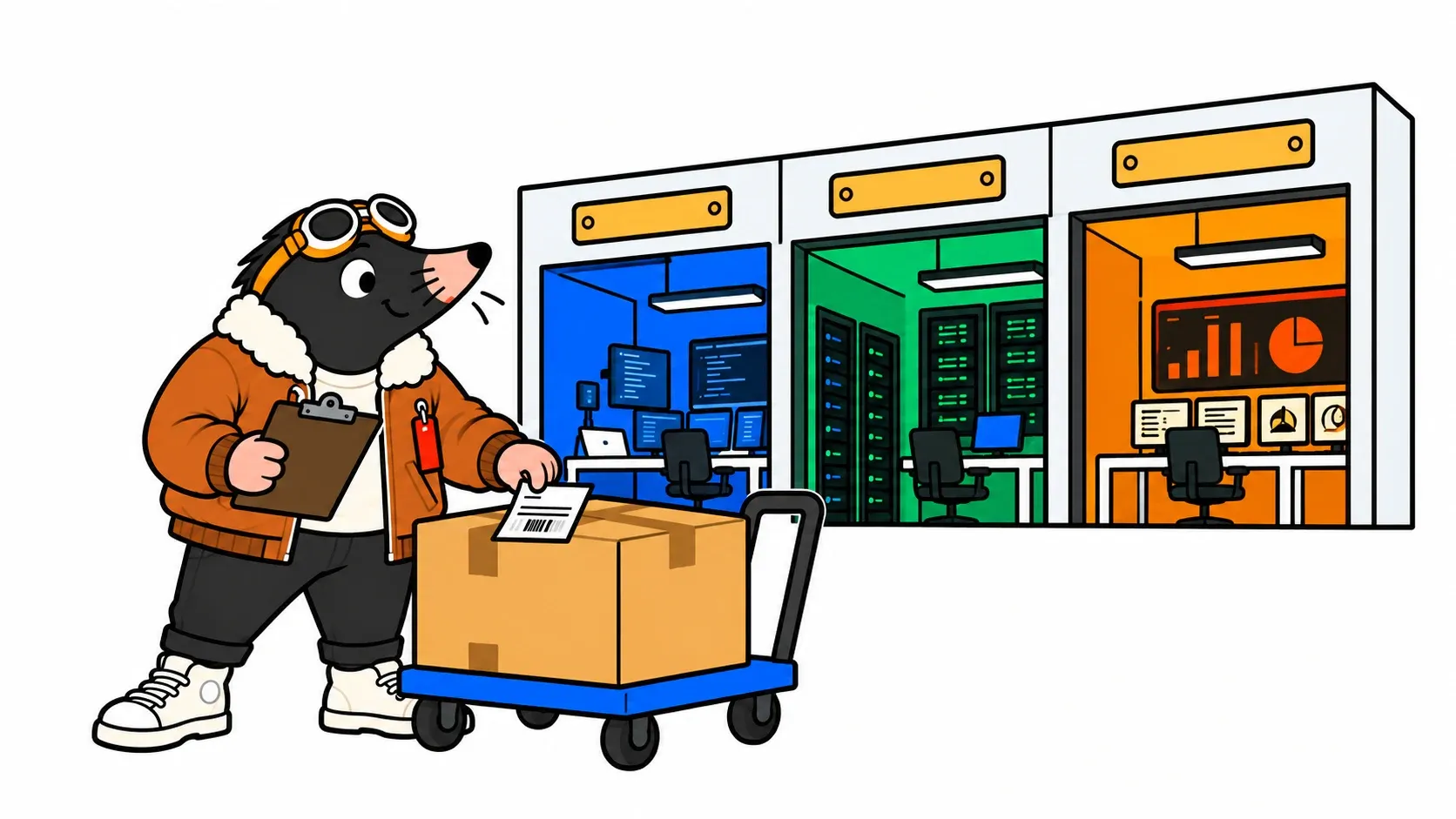
The pilot starts with a named list of consumers: team, form or API, integration version, environment, and owner. Then choose a short, reversible wave. The request router, documentation, and support process make clear which implementation receives a new request. Keep the old request path available to consumers who have not moved yet.
A mapping register connects the source request to the target resource: sourceRequest → targetDeploymentID, with owner, migration state, and links to IPAM, DNS, and CMDB records. It helps support teams and prevents an existing VM from being confused with its replacement. Do not assign the same IP address to two VMs at once, and do not allow two writers on the same application database. Data cutover needs its own owner and protocol.
For every wave, keep Day2 operations, lease handling, retries, and cleanup on the source system until its consumers and resources have migrated or been explicitly retired. If the new lane has already accepted writes, routing back does not roll data back: decide how to synchronize, reconcile, or restore before approving rollback.
Go/no-go before and after a wave
| Before — authorize only if… | After — continue only if… |
|---|---|
| The contract and wave consumers are known | Successful requests have the expected evidence |
| Capabilities, quotas, images, and permissions are ready | Day2, retries, and deletion meet the contract |
| Acceptance tests create, change, and delete without residue | IPAM, DNS, and CMDB match the actual state |
| A return path is written, including a data decision | Errors, duplicates, and orphaned resources are explained |
| Platform, service, and data owners are available | Owners accept the next wave or request a pause |
Pitfalls and things to watch
The catalog responds, but the service is not ready
A form that displays the new product proves neither that roles are correct, DNS and CMDB are updated, nor that cleanup works. Also avoid simultaneous mutations: the same address, record, or data changed through two lanes can produce a state that is impossible to reconcile.
Retirement is a later decision with its own prerequisites: a complete inventory of consumers and deployments, accepted identity and client migration where applicable, a restore rehearsal, a reversible stop with observation, a readable archive, and owner authorization. vIDM and Aria Suite Lifecycle have separate retirement dependencies; neither condition follows from the success of an All Apps service.
Conclusion
TOP does not schedule a one-time catalog switch. He protects the lane serving existing deployments and introduces new services by contract, test, and consumer wave. Every retired service needs a destination, proof that it works, an owner, and a clear data strategy.
Continuity is explicit. Source deployments stay managed by VM Apps.
The contract guides the rewrite. Create, Day2, delete, and dependencies belong together.
Retirement requires a decision. A completed pilot does not authorize deleting the old service.
Thanks to Alina Thylander for the VCF 9.1 capabilities overview, the Broadcom authors of the linked procedures and the documentation contributors. The diagrams, VM/IP/DNS/CMDB contract and transition checklists are our original operating proposals.
Get the next one by email
New articles and series, sent when they are published. No other mail.